





Solid Concrete Block Price in Chennai (2026): Size-Wise Rates, IS Standards & Buying Guide
Table of Contents
Solid concrete blocks in Chennai currently cost between ₹18 and ₹82 per piece, and that’s not a typo — the gap comes almost entirely from size and compressive strength, not from one supplier overcharging another. A 4-inch partition block and an 8-inch load-bearing block are simply different products, and mixing them up on a quote is the single most common mistake buyers make.
Key Takeaways
- 4-inch solid blocks run ₹18–₹45 per piece, 6-inch blocks ₹34–₹56, and 8-inch blocks ₹40–₹82, depending on strength grade and supplier.
- Solid blocks are denser and stronger than hollow blocks of the same size — use solid for load-bearing walls, hollow (or 4-inch solid) for non-load-bearing partitions.
- Compressive strength (measured in N/mm² or MPa) matters more than price alone — IS 2185 sets minimum standards, and a cheaper block below grade can compromise the wall.
- For a rough estimate, budget roughly 11–12 blocks per 10 sq.ft. of wall for the common 16″×8″ face size, accounting for mortar joints.
- Compare quotes on a like-for-like size and strength basis — a ₹5/piece “discount” often means a smaller or weaker block, not a genuine saving.
See the full construction material price list for cement, sand, blocks and bricks together.
Solid Concrete Block Price in Chennai, Size-Wise
| Block Size | Common Dimensions | Price per Piece |
|---|---|---|
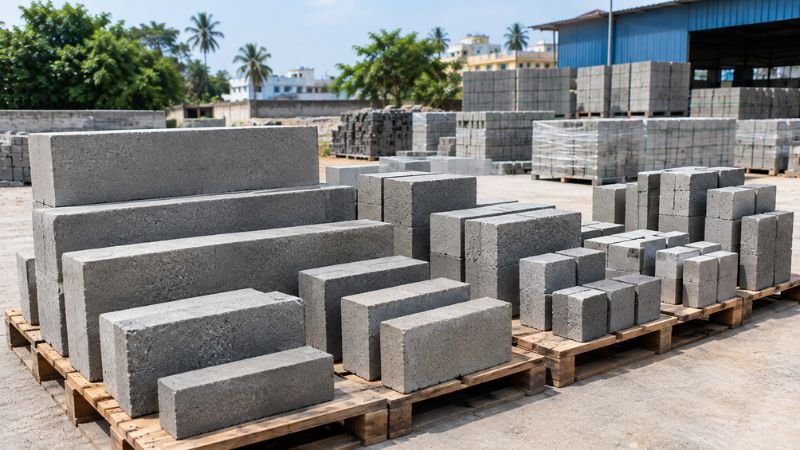
| 4 inch | 400×100×200 mm (16″×4″×8″) | ₹18 – ₹45 |
| 6 inch | 400×150×200 mm (16″×6″×8″) | ₹34 – ₹66 |
| 8 inch | 400×200×200 mm (16″×8″×8″) | ₹70 – ₹85 |
(Ranges reflect the typical spread across Chennai suppliers based on 2026 market listings; strength grade, curing quality, and order volume all move the price within these bands.)
For comparison, a standard hollow concrete block (400×200×200 mm) typically runs ₹46–₹65 per piece — often close to or even above the equivalent solid block, because hollow blocks use specialised moulding and are priced more on manufacturing complexity than raw material volume.
Solid Block vs Hollow Block — Which One Do You Actually Need?
This is the question worth getting right before you order, because using the wrong type in the wrong place either wastes money or weakens the wall.
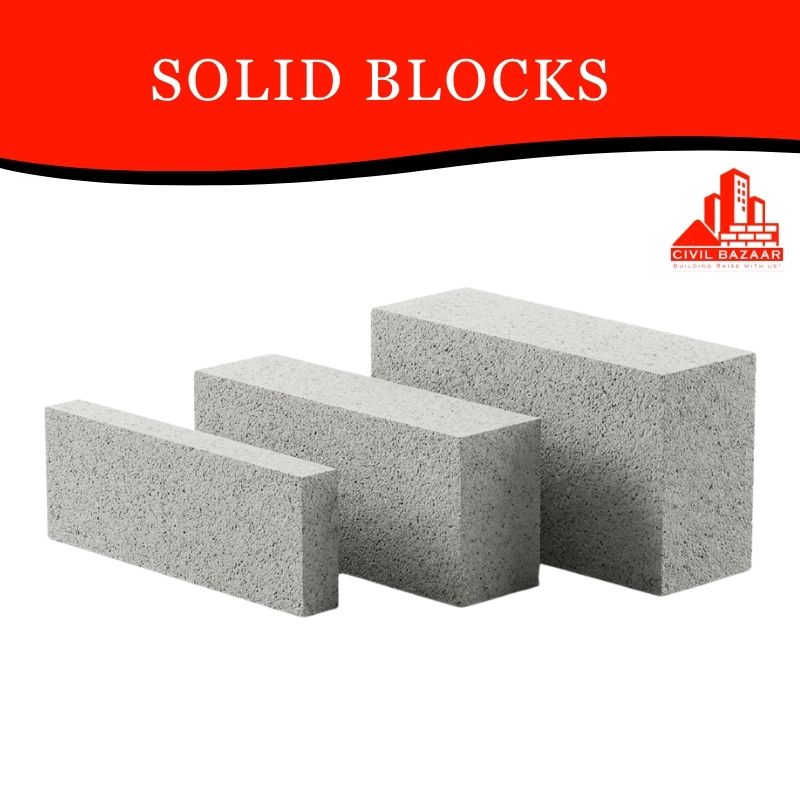
Solid concrete blocks are cast as one dense mass. They’re heavier, carry more load, and resist water penetration better — the natural choice for load-bearing walls, boundary/compound walls, foundations, and retaining walls.
Hollow concrete blocks have cavities running through them, which reduces weight and material use. They’re faster to lay, provide better thermal and sound insulation (the air gap helps), and are the standard choice for internal partition walls and non-load-bearing walls in framed (RCC column-and-beam) structures — which is how most Chennai homes are actually built.
Simple rule of thumb: if the wall is carrying structural load or facing the outside, go solid. If it’s an internal partition in an RCC-frame house, hollow (or a thinner solid block) does the job for less money and less dead weight on the slab.
For a deeper look, see hollow blocks vs solid blocks: which is stronger.
Understanding Compressive Strength — What the Numbers Mean
Solid blocks are graded by compressive strength, expressed in N/mm² (MPa). Under IS 2185 (Part 1), the relevant Indian Standard for concrete masonry units, common grades are:
| Grade | Compressive Strength | Typical Use |
|---|---|---|
| Grade A | 3.5 – 5.0 N/mm² | Light partition walls, non-load-bearing |
| Grade B | 5.0 – 7.5 N/mm² | General residential walls, single/double storey |
| Grade C | 7.5 – 10.0 N/mm² and above | Load-bearing walls, multi-storey buildings |
A block that looks identical on the outside can be a full grade weaker inside — this is where buying from an unfamiliar roadside supplier gets risky. Always ask for the strength rating, not just the size, especially for load-bearing and boundary wall applications.
These grades and testing methods come from IS 2185 (Part 1):2005, the Bureau of Indian Standards specification for hollow and solid concrete blocks.
Block quality also depends on the cement used to cast it — see our cement price in Chennai guide for grade selection.
How Many Blocks Do You Need?
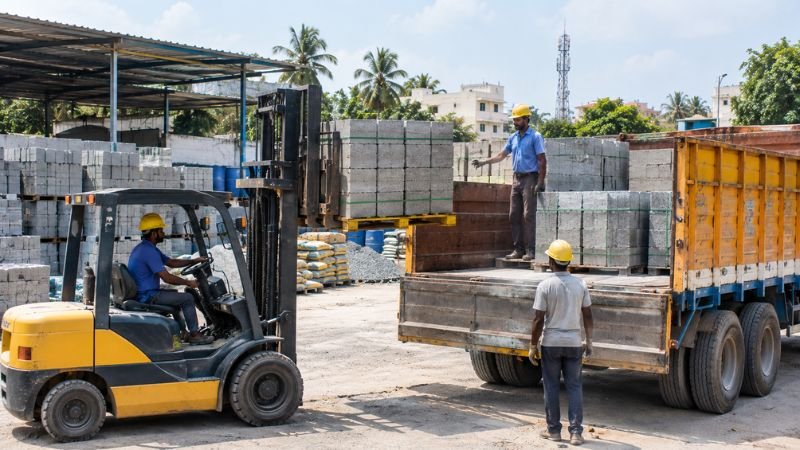
Using the common 16″×8″ (400×200 mm) face size, here’s a rough planning estimate accounting for a standard mortar joint:
- ~1.1 to 1.2 blocks per sq.ft. of wall face
- So for 100 sq.ft. of wall: roughly 110–120 blocks
- For a typical 1,000 sq.ft. house with an estimated 1,800–2,200 sq.ft. of total wall area (internal + external), budget roughly 2,000–2,600 blocks, split between solid (external/load-bearing) and hollow or thinner solid (internal partitions)
This is a planning-stage estimate, not a substitute for your architect’s or engineer’s exact wall schedule — always confirm against your approved drawing before placing a bulk order.
What Affects Solid Block Prices in Chennai
- Cement content. Solid blocks are essentially compressed cement, sand/M-sand, and aggregate — so when cement or M-sand prices move, block prices follow within weeks.
- Curing quality. Properly cured blocks (minimum 21–28 days) cost more to produce than blocks rushed to market early, but they’re also significantly stronger. A cheap block is sometimes cheap because it’s under-cured.
- Order volume. Bulk orders for a full project (thousands of blocks) get meaningfully better per-piece pricing than small, repeated top-up orders.
- Transport distance. Blocks are heavy and bulky — a supplier based close to your site (Padappai, Sriperumbudur, Tambaram) has a real cost advantage over one delivering from across the city.
Buying Tips Before You Order
- Ask for the strength grade in writing, not just the size — a supplier quote should specify N/mm² for load-bearing orders.
- Check the curing age. Blocks younger than 2–3 weeks haven’t reached full strength and shouldn’t go straight into load-bearing work.
- Inspect a sample batch for cracks, chipped edges, and consistent dimensions before accepting a full truckload.
- Match the block to the wall’s job — don’t default to 8-inch solid everywhere; it adds unnecessary cost and dead load on partitions that don’t need it.
- Get delivery timing right. Freshly delivered blocks stacked in direct sun and rain cycles (common in Chennai) can develop surface cracking if left exposed too long before use.
Frequently Asked Questions
What is the price of a solid concrete block in Chennai?
4-inch solid blocks cost approximately ₹18–₹45 per piece, 6-inch blocks ₹34–₹56, and 8-inch blocks ₹40–₹82, depending on compressive strength grade and supplier.
Is a solid block stronger than a hollow block?
Yes, generally. A solid block of the same size carries more load and resists water better because it has no internal cavities. Hollow blocks are lighter and better insulated, making them the standard choice for non-load-bearing internal walls rather than structural ones.
Which IS standard applies to solid concrete blocks?
IS 2185 (Part 1) covers concrete masonry units, including solid concrete blocks, and defines minimum compressive strength grades (roughly 3.5 to 10+ N/mm² across Grades A, B, and C).
How many solid blocks do I need for 100 sq.ft. of wall?
Using the common 16″×8″ face size, budget roughly 110–120 blocks per 100 sq.ft. of wall area, accounting for standard mortar joints. Confirm against your engineer’s exact wall schedule before ordering.
Should I use solid or hollow blocks for an RCC-frame house?
For internal partition walls in an RCC column-and-beam house, hollow blocks (or thinner solid blocks) are usually sufficient and lighter on the slab. Reserve full 8-inch solid blocks for external, boundary, and any genuinely load-bearing walls.
Need delivery? See our building materials supplier page for Padappai for contact details and coverage areas.
Prices are indicative market ranges for 2026 and vary with strength grade, curing quality, and order volume. Confirm the live rate and available strength grades with CivilBazaar Chennai before placing an order — call or WhatsApp for today’s pricing and delivery to Padappai, Sriperumbudur, Tambaram, and surrounding areas.


