






Best Cement Price in Chennai Today: Brand-Wise Rates, OPC vs PPC & Buying Guide
Table of Contents
If you’re buying cement in Chennai this month, expect to pay somewhere between ₹355 and ₹455 per 50 kg bag, depending on the grade and brand you pick. That’s a real difference of ₹5,000+ on a mid-sized house, so it’s worth five minutes to understand what you’re actually paying for before you order.
Key Takeaways
- OPC 43 grade cement in Chennai runs roughly ₹380–₹405 per 50 kg bag; OPC 53 grade runs ₹405–₹430.
- Branded cement (UltraTech, Ambuja, ACC) typically costs ₹15–₹40 more per bag than the unbranded/local rate for the same grade — you’re paying for consistency, not just the name.
- PPC (fly-ash blended) cement is usually the cheapest option and is fine for most residential plastering and non-structural work.
- Chennai’s price is close to the national average — the city isn’t unusually expensive for cement, because the Ariyalur plant belt is nearby.
- Bulk/dealer rates can run 5–8% below retail single-bag rates — always ask for the bulk price if you’re buying a full truckload.
See the full construction material price list for cement, sand, blocks and bricks together.
Cement Price in Chennai Today, Grade-Wise
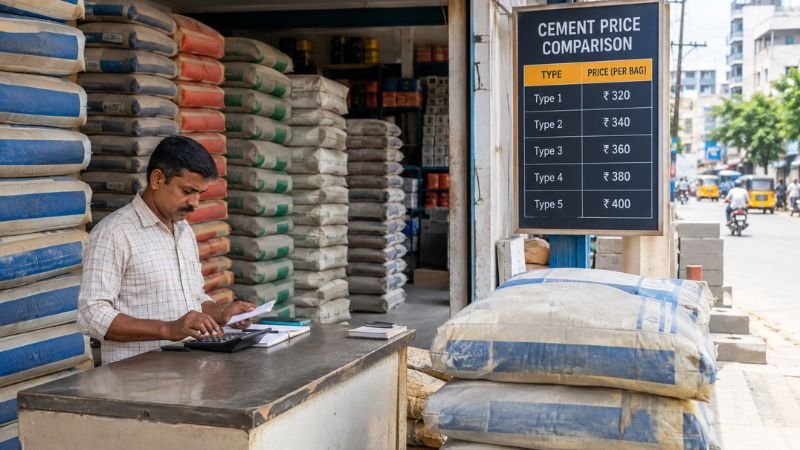
Here’s the current price band by grade, based on dealer-to-retail spreads seen across Chennai suppliers in 2026:
| Cement Type | Price per 50 kg bag | Best Used For |
|---|---|---|
| OPC 43 Grade | ₹380 – ₹405 | General RCC work, plastering, non-critical structural work |
| OPC 53 Grade | ₹405 – ₹430 | High-strength RCC, columns, slabs, structural work |
| PPC (Fly Ash blended) | ₹380 – ₹423 | Plastering, mass concrete, most residential walls |
| PSC (Slag cement) | ₹391 – ₹433 | Foundations, marine/coastal work, mass concreting |
| White Cement | ₹19 – ₹27 per kg | Tile joints, finishing, decorative work |
(Figures indicate dealer-to-retail spread across Chennai, based on 2026 market data. Actual rates move weekly — always confirm before placing a bulk order.)
Brand-Wise Cement Price in Chennai
Grade tells you the strength class. Brand tells you the consistency and quality control behind that strength — and that’s where the real price spread shows up.
| Brand | Common Variant | Approx. Price per Bag |
|---|---|---|
| UltraTech | OPC 53 | ₹422 – ₹467 |
| UltraTech | PPC | ₹392 – ₹435 |
| Ambuja | OPC 53 (Plus) | ₹407 – ₹462 |
| Ambuja | PPC (Compocem) | ₹369 – ₹421 |
| ACC | OPC 53 (Gold) | ₹400 – ₹462 |
| ACC | PPC (F2R) | ₹374 – ₹421 |
| Shree | OPC 53 (Bangur) | ₹376 – ₹432 |
| Shree | PPC (Rockstrong) | ₹353 – ₹405 |
(Brand premiums are indicative and inferred from typical market positioning; actual dealer rates in Padappai/Sriperumbudur can differ. Ramco, Dalmia, and Chettinad — all manufactured close to Chennai via the Ariyalur belt — are usually priced competitively against these national brands, often ₹5–₹15 per bag lower.)
See how much it costs to build a house in Chennai for the full per-sq.ft. cost breakdown.
OPC vs PPC vs PSC — Which One Should You Actually Buy?
This is the question that matters more than the brand name.
OPC (Ordinary Portland Cement) gains strength faster and is the standard choice when you need high early strength — columns, beams, slabs, anything load-bearing.
PPC (Portland Pozzolana Cement) is blended with fly ash. It gains strength more slowly but is more workable, generates less heat during curing (good for mass concrete), and is usually the cheaper option. For plastering, boundary walls, and most residential masonry, PPC does the job fine and saves money.
PSC (Portland Slag Cement) is blended with slag instead of fly ash. It’s less common for home construction but performs well in foundations and any work exposed to sulphate-rich soil or coastal moisture — relevant if you’re building near Chennai’s coastal belt.
Simple rule of thumb: structural RCC (columns, slabs, beams) → OPC 53. Everything else (plastering, blockwork, boundary walls) → PPC.
Grade and strength requirements for OPC are set by IS 269:2015, the Bureau of Indian Standards specification covering 33, 43, and 53 grade cement — worth asking your supplier whether their bags carry the ISI mark against this standard.
What Actually Moves Cement Prices in Chennai
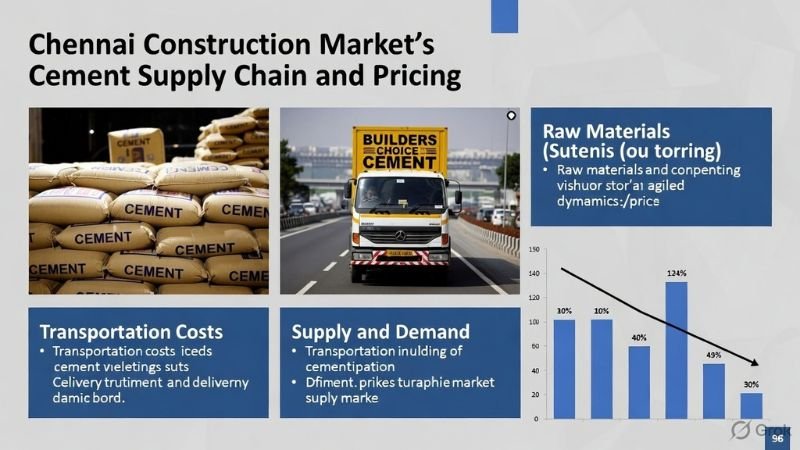
Buyers often assume cement prices are fixed by the company. In reality, they move for reasons that have nothing to do with the cement itself:
- Fuel and freight costs. Cement plants run on coal/pet coke, and freight adds up fast over distance. A fuel price spike shows up in bag prices within weeks.
- Packaging cost. This sounds minor but isn’t — cement bag prices alone have jumped several rupees per bag industry-wide in recent quarters due to packaging material costs.
- Regional demand. South India, and Tamil Nadu especially, has strong ongoing construction demand, which keeps prices firmer here than in some other regions.
- Proximity to the Ariyalur cement belt. This is actually good news for Chennai buyers — because major plants (Dalmia, Ramco, Chettinad) sit within roughly 250 km, Chennai’s cement prices stay close to the national average instead of carrying a big transport premium, unlike sand (where Tamil Nadu’s mining restrictions push prices up instead).
How Many Cement Bags Do You Need?
A rough, widely-used estimate for standard residential RCC construction:
- ~0.4 bags of cement per sq.ft. of built-up area for the RCC structure alone (foundation to roof)
- Add roughly 15–20% more if you’re accounting for plastering and blockwork mortar separately
So for a 1,000 sq.ft. house:
- Structure: ~400 bags
- Plastering + blockwork: ~60–80 additional bags
- Total: roughly 460–480 bags, split across OPC (structure) and PPC (plastering/blockwork)
This is a planning estimate, not a substitute for your structural engineer’s bill of quantities — always confirm exact quantities against your approved drawing.
Planning blockwork too? See our solid concrete block price guide for size-wise rates.
Buying Tips Before You Order
- Ask for the bulk rate, not the retail single-bag rate, if you’re ordering more than a truckload — the gap is usually 5–8%.
- Check the manufacturing date on the bag. Cement loses strength after about 3 months of storage, faster in humid conditions like Chennai’s.
- Match grade to purpose rather than buying OPC 53 for everything — it costs more and isn’t necessary for plastering or blockwork.
- Confirm delivery timing for large orders. Cement can’t sit exposed on-site in Chennai’s humidity for long, so time the delivery close to when it’ll actually be used.
Cement Price in Chennai vs Other Tamil Nadu Cities
Chennai isn’t the cheapest city in the state for cement — and it’s useful to know why, especially if a contractor ever quotes you a lower “Coimbatore rate.”
| City | OPC 53 Grade (per bag) | PPC (per bag) | Why |
|---|---|---|---|
| Chennai | ₹405 – ₹430 | ₹380 – ₹423 | Close to Ariyalur belt, but port-driven industrial demand and cyclone-season logistics add periodic volatility |
| Coimbatore | ₹411 – ₹452 | ₹370 – ₹411 | Slightly higher OPC due to distance from the main plant cluster |
| Tiruchirappalli (Trichy) | ₹418 – ₹461 | ₹358 – ₹398 | Sits inside the Ariyalur/Trichy plant belt itself — often the cheapest PPC rates in the state |
The takeaway: if you’re near the Chennai–Trichy highway corridor, transport cost is what decides your final price more than the brand does. For deliveries within Padappai, Sriperumbudur, and Tambaram, that transport cost is already low since it’s a short haul from the depot.
Cement’s Share of Your Total Construction Budget
It’s easy to fixate on the per-bag price and lose sight of the bigger picture. Cement typically makes up 10–15% of total construction cost for a standard residential build — meaning steel, sand, blocks, and finishing materials together account for the rest.
Practically, this means:
- Chasing a ₹10/bag discount across 460 bags saves roughly ₹4,600 — useful, but small next to a 1,000 sq.ft. build costing ₹20–26 lakhs.
- It’s usually more valuable to get the grade selection right (not over-specifying OPC 53 where PPC would do) than to chase the absolute lowest per-bag price from an unfamiliar supplier.
- Consistency matters more than the odd cheap batch — a weak or under-cured bag that compromises a slab costs far more to fix than it ever saved.
See the full house construction cost per sq.ft. in Chennai breakdown for how cement fits into the total budget.
How to Store Cement Properly on Site
Chennai’s humidity is genuinely hard on cement, and poor storage is one of the most common ways buyers waste money after the purchase is already made.
- Keep bags off the ground. Stack on a wooden pallet or a raised platform, never directly on bare earth or a damp floor.
- Stack away from outer walls. Bags touching an outer wall absorb moisture from it, even indoors.
- Cover with tarpaulin, especially during Chennai’s monsoon window (October–December), even if the cement is stored inside a shed.
- Use oldest stock first (first-in, first-out). Cement loses roughly 20% of its strength after 3 months of storage and more after 6, even when stored well.
- Limit stack height to 10 bags to avoid the bottom bags getting compacted and hardened under the weight.
If you’re ordering in phases rather than all at once, that’s usually smarter than storing several months’ worth of cement on-site — it avoids the strength-loss problem entirely.
Common Cement-Buying Mistakes to Avoid
- Over-specifying OPC 53 everywhere. It costs more than PPC and isn’t needed for plastering, blockwork, or non-structural elements.
- Buying purely on brand name. Ramco, Dalmia, and Chettinad are manufactured close to Chennai and perform comparably to the bigger national brands at a lower price — worth comparing before defaulting to the most-advertised name.
- Ignoring the manufacturing date. A bag that looks fine on the outside can already have lost meaningful strength if it’s been sitting in a warehouse for months.
- Ordering the full quantity upfront for a long project. Phased delivery matched to your construction schedule avoids storage losses in Chennai’s humidity.
- Not asking for the bulk rate. Many buyers pay the retail per-bag price even when ordering truckload quantities, simply because they didn’t ask.
Frequently Asked Questions
What is the cement price in Chennai today?
OPC 43 grade cement costs approximately ₹380–₹405 per 50 kg bag, OPC 53 grade costs ₹405–₹430, and PPC costs ₹380–₹423 per bag as of 2026. Branded cement (UltraTech, Ambuja, ACC) sits at the higher end of these ranges.
Which cement is best for house construction — OPC or PPC?
Use OPC 53 for structural RCC work (columns, beams, slabs) where early strength matters. Use PPC for plastering, blockwork, and boundary walls, where it’s more economical and equally suitable.
Why is cement in Chennai cheaper than sand?
Chennai sits close to the Ariyalur cement manufacturing belt, keeping cement transport costs low. Sand, on the other hand, is restricted by Tamil Nadu’s strict river-sand mining rules, which pushes sand prices up independently of cement.
How many cement bags do I need for a 1,000 sq.ft. house?
As a planning estimate, budget roughly 460–480 bags total — about 400 for the RCC structure and 60–80 more for plastering and blockwork mortar. Always confirm exact quantities against your engineer’s bill of quantities.
Is bulk cement cheaper than buying bag by bag?
Yes — bulk/dealer rates typically run 5–8% below retail single-bag pricing. Always ask for the bulk price if you’re ordering a full truckload for a project.
How long can cement be stored before it loses strength?
Cement stored properly (off the ground, covered, away from damp walls) starts losing strength after about 3 months and loses more after 6. In Chennai’s humidity, poor storage speeds this up significantly, so it’s better to order in phases matched to your construction schedule than to stockpile everything upfront.
Is cement cheaper in Chennai than in other Tamil Nadu cities?
Not always. Cities closer to the Ariyalur/Trichy cement plant belt, like Tiruchirappalli, often get slightly lower PPC rates than Chennai. Chennai’s prices stay competitive because it’s still within reasonable transport distance, but it isn’t the cheapest city in the state.
What percentage of my construction budget goes to cement?
Cement typically accounts for 10–15% of total construction cost on a standard residential build. Steel, sand, blocks, and finishing materials make up the rest — so getting the right grade for each use matters more for your overall budget than chasing the lowest possible per-bag price.
Need delivery? See our building materials supplier page for Padappai for contact details and coverage areas.
Prices are indicative market ranges for 2026 and change weekly with fuel, freight, and demand. Confirm the live rate with CivilBazaar Chennai before placing an order — call or WhatsApp for today’s dealer pricing and delivery to Padappai, Sriperumbudur, Tambaram, and surrounding areas.


